



A message by Pastor Paul M. Sadler from the 2001 Berean Bible Fellowship Conference.
Author Archives: Pastor Paul M. Sadler
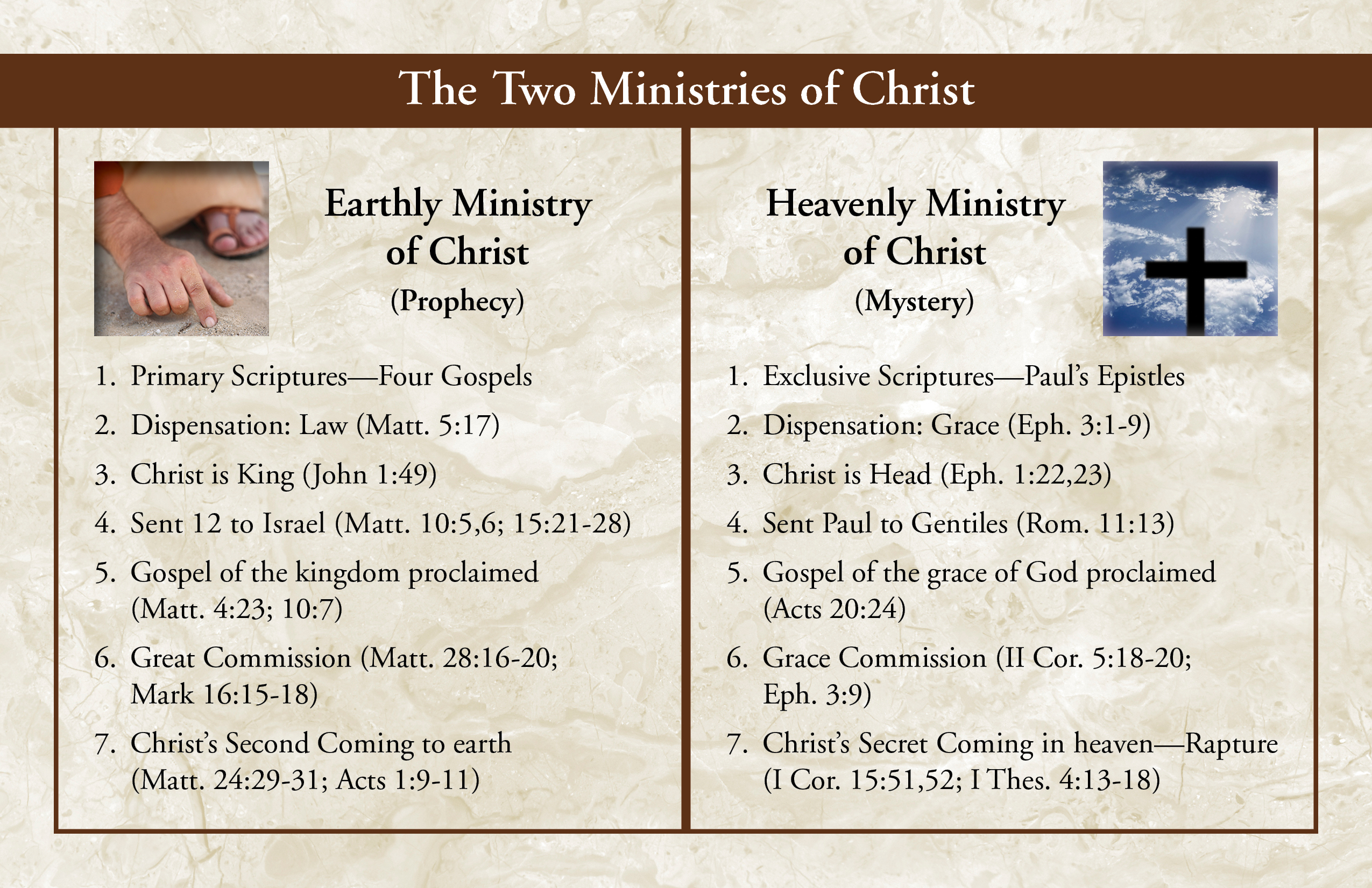
The Two Ministries of Christ
A Precious Commodity
It has been said that “when Raphael died at thirty-seven years of age, they carried his marvelous painting, ‘The Transfiguration,’ only half finished, in the funeral procession as a symbol of the incompleteness of life and the brevity of time.”
Time is a precious commodity! When the Apostle Paul instructed the Ephesians to redeem the time, he wanted them to make wise use of it. They were not to squander it on worldly pursuits that would draw them away from the things of the Lord. But redeeming the time also implies taking advantage of opportunities that present themselves in life. When Paul, for example, was unjustly incarcerated at Rome, he did not view his circumstances as a setback in his ministry, but as an opportunity for the furtherance of the gospel. It gave him access to Caesar’s household that he would not have otherwise had. And as a result, many were saved.
Rather than dwell on his mitigating circumstances that would have only frustrated the grace of God, Paul instead chose to produce what is perhaps his greatest body of work—his Prison Epistles that continue to minister to the Body of Christ to this very day. This is why it is important to follow Paul’s example, that we too might be more productive in the Lord’s service. His unfaltering love and devotion to the Savior, Who saved him on the road to Damascus, was the motivating influence in his life, as it should be in ours.
As you read these lines, there will be numerous opportunities throughout the coming year to make a difference in someone’s life. But it is essential to take advantage of them as Paul did. Perhaps it’s a neighbor down the street who needs a helping hand. Reach out to them, as the Lord reached out to us; and when you do, take the gospel with you. Become a mentor to someone who is new to the faith, someone who has more questions than answers about the Word of God. Make a difference in someone’s life. Only eternity will bear out the fruits of your labor for Christ. You will be amazed when you get to Glory and someone walks up to you and says, “Thank you for the word of encouragement that day, it was a turning point in my Christian life.”
May God help us to live every day in light of the Judgment Seat of Christ, where we will all stand astounded at what could have been.
Faithful Pastors
A message by Pastor Paul M. Sadler from the 1990 Berean Bible Fellowship Conference.
God’s Unconditional Love
“But God commendeth [directed] His love toward us, in that, while we were yet sinners, Christ died for us” (Rom. 5:8).
We often hear couples speak of their love for one another after years of marriage, but there is a greater and deeper love—the love of God. The above is perhaps one of the most profound verses in the Word of God. It is amazing when we consider that God has directed His love toward us. But in what way did He do so? The answer is found in the very next statement: “while we were yet sinners, Christ died for us.” In other words, when we were in total rebellion against God, dead in trespasses and sins, and shouting profanities in the face of God out of hatred for Him, God intervened to provide a way of salvation. In unconditional love, He sent His Son, the Son of His love, to die for His enemies—you and me!
God has made a provision for all, but only those who place their faith in the finished work of Christ at Calvary will be saved from their sins. You see, God will not accept your good works for salvation. The Word of God could not be clearer on the matter: “Not by works of righteousness which we have done, but according to His mercy He saved us” (Titus 3:5). Perhaps you are wondering: “What must I do to be saved?” It is simply this: Believe on the Lord Jesus Christ, that He died for your sins, and rose again (I Cor. 15:3,4). The moment you trust Christ as your personal Savior, all of your sins will be forgiven, and God will grant you the free gift of eternal life.
God loves you; Christ died to save you; what more could He do for you? Trust Him today before it’s too late. Believe me when I say, you do not want to leave this life without Christ. To do so will leave you with an eternity of regret, because there are no second chances beyond the veil of death—it’s now or never! Believe on the Lord Jesus Christ, and God will save you wonderfully by His grace. But the good news does not end here; He will also give you a new life in Christ!
A Worry-Free Life
“Go to now, ye that say, Today or tomorrow we will go into such a city, and continue there a year, and buy and sell, and get gain: Whereas ye know not what shall be on the morrow. For what is your life?…For that ye ought to say, If the Lord will, we shall live, and do this, or that” (James 4:13-15).
The desire of James’s heart was that his readers would humble themselves before the Lord and not be presumptuous when they planned for the future, nor to worry about it. We might call it worry-free planning! We all probably know someone who gets worried when they don’t have something to worry about! Believers also struggle with this problem, but the Scriptures state, “Be careful [anxious] for nothing” (Phil. 4:6). In our contemporary language we would say, “Don’t worry about anything.” The Greek root word behind the term “careful” here is merimna, which means to pull in different directions or a distraction. This is exactly what worry will do to you: it will tear you apart, both emotionally and physically. Worry always dwells on the future in regard to what may or may not happen. It mulls over every worst-case scenario imaginable until you are tied in knots. We might say it this way: the past belongs to the ages, the present belongs to us, but the future belongs to God.
Worry is a sin! It focuses on the future, which is divine ground. The only suitable way to deal with it is to find a biblical solution to the problem. Thankfully, the Scriptures provide for us the key to living a worry-free life. This age-old problem that can be traced back to the Fall has a simple solution. In fact, the antidote to this venomous attack is the same in every age. We find it noteworthy that the Lord Himself dealt with this matter as He prepared the disciples to carry out the Great Commission.
“Therefore I say unto you, Take no thought for your life, what ye shall eat, or what ye shall drink; nor yet for your body, what ye shall put on. Is not the life more than meat, and the body than raiment? Behold the fowls of the air: for they sow not, neither do they reap, nor gather into barns;
yet your heavenly Father feedeth them” (Matt. 6:25,26).
We are creatures of habit! We like the security of having a roof over our heads and knowing where we’re going to have dinner tonight. The same was true of the disciples, with this exception: the Lord had uprooted them from their comfort zone and transplanted them in His field of service. When He called them, they left their families and livelihoods to follow Him. At first it seemed the right thing to do, but the more they thought about their decision, it left them with a feeling of insecurity. In short, they were worried sick! What will we wear when the weather turns inclement? Who’s going to provide our meals today, and tomorrow, and next week? Goodness gracious, we completely forgot about our families! Who’s going to supply that need? Worry always has a way of producing more questions than answers.
Sensing their apprehension, the Lord said, “Take no thought for your life.” “Take no thought” is another way of saying, “Don’t worry about what may or may not happen!” Life is more than food and drink and clothing; they were to be more concerned about the spiritual things of God. If God can provide for the birds that fly above, which neither plant nor harvest, surely He is able to supply the needs of His laborers. We must bear in mind that, if God foreordained the Cross in His determinate counsel (Acts 2:23), and the Lamb was slain before the foundation of the world (I Pet. 1:19,20) in accordance with His foreknowledge, surely He knows every need of the disciples, not to mention ours, in advance (Matt. 6:32).
“Take therefore no thought for the morrow: for the morrow shall take thought for the things of itself. Sufficient unto the day is the evil thereof” (Matt. 6:34).
This passage is the Lord’s solution to the problem of worry. They were not to concern themselves with tomorrow’s circumstances, simply because those were beyond their control. It is natural to be concerned, but they weren’t to allow their concern to deteriorate into worry that consumed them because it would only serve to disrupt their service for Christ. Our Lord speaks of two days: tomorrow, a reference to the future, which belongs to God, and today. While it is impossible simply to turn off unwarranted concern, they were to redirect it. “Sufficient unto the day is the evil thereof.” In other words, there were enough troubles to deal with in any given day without concerning themselves with tomorrow. The answer to the sin of worry is to trust in God and focus on resolving the problems that are facing you today (Phil. 4:19).
Is Paul Addressing Believers or Unbelievers?
“I’m confused! In Philippians 3:17-20, is Paul addressing believers or unbelievers?”
“17 Brethren, be followers together of me, and mark them which walk so as ye have us for an example.
“18 (For many walk, of whom I have told you often, and now tell you even weeping, that they are the enemies of the Cross of Christ:
“19 Whose end is destruction, whose God is their belly, and whose glory is in their shame, who mind earthly things)
“20 For our conversation [citizenship] is in heaven….”
Paul is addressing both groups! In verse 17 the apostle begins by encouraging those at Philippi who were saved to follow his teachings and manner of life. Notice, however, that he digresses in verses 18 and 19 to add a parenthetical thought. The reason the apostle pauses momentarily here is to point out that there were many who claimed to be Christians, probably for some type of personal gain, but he clearly exposes them to be enemies of the Cross of Christ. They lived to satisfy the desires of the flesh. Their god was food, and drink, and sex, as they gloried in their shame. They were consumed with earthly possessions, which blinded them to their need of the Savior. As a result, their “end is destruction!” Surely this could not be said of the believer. After Paul completes the parenthesis, he resumes with his initial train of thought, confirming our heavenly hope with the saints at Philippi, “For our citizenship is in heaven….”
Are There Physical Blessings Today?
“Pastor Sadler, you referred to our having physical blessings today. What exactly do you believe those are?”
While we are primarily blessed with all spiritual blessings in the heavenlies (Eph. 1:3), God has also blessed us with physical things. The Bible that you hold in your hand is a physical book with a spiritual message.
When we observe the Lord’s Supper, we are partaking of physical elements, the bread and the cup, which convey a spiritual message (I Cor. 11:23-26).
“For every creature of God is good, and nothing to be refused, if it be received with thanksgiving: For it is sanctified by the Word of God and prayer” (I Tim. 4:4,5).
The very food we eat everyday would also be classified a physical blessing. Notice that “every creature of God is good”; that is, every piece of beef, chicken, pork, fish or shellfish we eat is good and not to be withheld as unclean today. Under grace, eating a ham sandwich is acceptable. Paul adds that it is set apart by God in accordance with His Word and prayer, a clear indication that we are to offer thanks to the Lord for what we have at every meal.
The apostle instructed Timothy, “having food and raiment let us be therewith content” (I Tim. 6:8). While we are clothed spiritually in Christ’s righteousness, I wouldn’t advise leaving home physically unclothed. Our very clothing is a physical blessing.
In the context of prayer, Paul prayed that he might have the Lord’s prospering on his physical journey to visit the saints at Rome (Rom. 1:9,10). “In everything [not just some things and not just spiritual things] give thanks: for this is the will of God in Christ Jesus concerning you” (I Thes. 5:18).
The Second Trumpet
“And the second angel sounded, and as it were a great mountain burning with fire was cast into the sea: and the third part of the sea became blood; And the third part of the creatures which were in the sea, and had life, died; and the third part of the ships were destroyed” (Rev. 8:8,9).
The blast of the second trumpet sends an object hurling out of the heavens that will destroy a third part of marine life, as well as a third part of the ships at sea. The Holy Spirit is careful to add that this heavenly body was “as it were a great mountain.” In other words, it was not a mountain as such, but had characteristics like a mountain—it was immense and had the appearance of solid rock. This could well be a description of an asteroid, which has many of the same features.
An asteroid can range from a few feet in diameter to hundreds of miles across and everything in between. There are tens of thousands of them, orbiting the sun in what’s called a band asteroid belt. It is well known that asteroids frequently pass by the earth, normally at great distances. Here it seems apparent that the finger of God will supernaturally alter the course of one of these heavenly objects. If a large asteroid were to pass through our atmosphere, we would probably describe it the same way that John did, as a mountain burning with fire.
The Apostle John then observed that this massive missile was cast into the sea. In all probability, this is the Mediterranean Sea since the second bowl judgment of Revelation 16 will be far more extensive and destructive to the oceans of the world. It has been said, “The steps of God from mercy to judgment are always slow, reluctant, and measured.” At this stage of the trumpets, God’s judgments will still be tempered with mercy so as to give men an opportunity one last time to repent and turn to Him in faith; the full scope of His fury will be unleashed later, in the bowl judgments. The surface area of the Mediterranean Sea is roughly 965,300 square miles, a third of which would be 321,767 square miles. Once again, to give you some idea as to the extent of this second judgment, the area of the Mediterranean affected would be greater than the State of Texas.
An asteroid, or whatever this enormous object is, falling into the Mediterranean Sea will be catastrophic. John is very careful to point out that before the death of marine life, “the third part of the sea became blood,” reminiscent of Egypt again, when God supernaturally turned the water into blood (Ex. 7:20). Multiply that miraculous event a hundredfold, and you have some idea of the severity of this judgment. Men will undoubtedly look on in horror as the sea turns to crimson.
The apostle then adds, “And the third part of the creatures which were in the sea, and had life, died.” The death of marine life will not cause the bloody sea; to the contrary, the bloody sea will kill the marine life. Creatures of the sea such as fish, dolphins, and turtles will be unable to survive in these conditions. The result will be death on a grand scale! If you’ve ever gone fishing, you know that one dead fish on the water’s edge is enough to drive you to another fishing spot. Imagine millions of fish floating on the surface of the water; the stench will be unbearable, as it was in Egypt (Ex. 7:21).
“And the third part of the ships were destroyed.” An asteroid a mile wide, hitting the earth at 30,000 miles per hour would produce 10 to 50 million times the energy of the atom bomb that was dropped on Hiroshima during World War II. It would “flatten everything for 100 to 200 miles out from ground zero.” The carnage will be incomprehensible as many shipyards will be totally wrecked. Those ships at sea within the range of this blast will capsize and be swept away by the ensuing tidal waves. The aftermath of this judgment will devastate the fishing industry and hamper world shipping and trade on an unprecedented scale. It will be a financial disaster for hundreds of ports of call that rely on tourism.
As we are already witnessing, the Lord will be like a mighty man of war in the day of battle, with a military strategy that will make the warmongers of this world tremble (Isa. 42:13). With just two blasts of the trumpets, He will decimate trade and commerce on both land and sea.
This article is an excerpt from Volume 2 of Pastor Paul Sadler’s commentary on the book of Revelation.
Rescued!
I am sure we have all stood breathless as we have watched rescue efforts being undertaken by daring men. One of the more memorable rescues of late has been that of little Jessica McClure from a well shaft in Texas. Jessica had accidentally fallen into an abandoned well shaft and was trapped for two and one-half days without food or water. With her fragile life hanging in the balance, rescue workers labored tirelessly around the clock to free that precious little soul from danger. The heroic efforts of those men and women will be remembered for many years to come. After all, they saved a life.
Another rescue effort that is above all others and deserves our special attention is when God rescued us from the depths of iniquity. Ever since the Fall all of us have staggered under the terrible penalty of sin; sin, that would have sunk a world to the blackness of hell forever. But, while we were under the sentence of condemnation God undertook the greatest rescue effort this world has ever known.
THE BLOOD OF CHRIST
“In whom we have redemption through His blood…” (Eph. 1:7).
It is important to notice Paul’s emphasis here on the person of Christ as he uses phrases such as “In Whom” and “His blood.” Why did God send His only begotten Son to redeem us? Why didn’t He call on someone from the human race? You see, one from the human race could never save us because sin has condemned the entire race. The testimony of Scripture is true, “For all have sinned and come short of the glory of God” (Rom. 3:23). I could not possibly die for your sins, because I have sins of my own that placed me under the sentence of death. I could not redeem you nor could you redeem me, because we are all in the same boat and it is sinking from the weight of our iniquity.
Understanding that the “wages of sin is death,” we conclude that death had absolutely no claims on Christ. But who is this hanging on the Cross writhing in the agony of pain? Why, it is the form of one dying, whose visage is marred beyond recognition—dying for us! To our amazement, it is God’s only begotten Son! But this cannot be. He knew no sin; death cannot claim this Holy One of God! True, except for the fact that He was not dying for His own sins, but rather, for our transgressions. Our sins were transferred to Christ and the wrath of God fell upon His Son who voluntarily died our death.
So then, we have redemption through Christ’s shed blood. Spiritually speaking, His precious blood cleanses us from the disease of sin that plagues us. Christ was made sin for us, that we might be made the righteousness of God in Him.
HOW TO BE SAVED
Have you submitted yourself to God’s wonderful rescue operation? Dear sinner friend, won’t you come to Calvary? It was there that God reconciled the world to Himself. In His infinite love He provided a plan of salvation based on the precious shed blood of His Son. Please bear in mind that, “you must come to Christ in God’s way!” He will not accept your good works, church membership, baptism or confirmation. If these things could save us, then Christ died in vain. It was because these things were not acceptable in themselves that God sent His Son to earth to die for the sins of the world.
Lay hold of the Savior, for only He can rescue you from eternal condemnation and bring you safely to the shores of eternal life. Simply believe on the Lord Jesus Christ, that He died for your sins, was buried and rose again the third day (1 Cor. 15:1-4).
Do you have questions about your salvation? Contact us using our Ask A Question page and we would love to share with you more about what God’s Word has to say.
This article is also available as a tract from our bookstore.
Should Believers Be Called “Christians”?
“‘And the disciples were called Christians first in Antioch’ (Acts 11:26). The Apostle Paul addresses believers as saints, brethren, and the faithful in Christ Jesus, but never Christians. Should not believers today be more properly called ‘grace believers’ instead of Christians as so many denominations do?”
The term “Christian” is a title that was originally given to us by the world. Notice, the believers were “called Christians first in Antioch.” These believers spoke so frequently and affectionately of Christ that the world coined the term Christians. Of course, they meant it in a derogatory sense. The citizens of Antioch were famous for their witty quips; they were the punsters of their day. Since this expression has a Latin origin, it was probably the Romans among them who first assigned this name to believers.
Be that as it may, we have no major objection to believers being called Christians, based on Acts 11:26; 26:28, and 1 Peter 4:16. Today, however, the word is so sweeping that it includes both believers and religious unbelievers. While a true believer is a Christian, one who calls himself a Christian may not necessarily be saved. With that said, we prefer the terminology “believer,” “saved,” “brethren,” “saints,” or “faithful in Christ Jesus.” We would also include the designation “grace believers,” the sense of which is drawn from Paul’s letters, but it should be remembered that not all believers are “grace” as we understand the usage.
A Guilty Conscience
Four of our grandchildren have a large high-spirited dog named Molly. Molly is like most dogs; she loves to eat and romp with the kids. But she also likes to roam the neighborhood, crashing through the neighbor’s flowerbeds and vegetable gardens. Needless to say, a dog her size could do a lot of damage in short order. To correct the problem, Kevin and Jessica purchased an electronic collar. They merely set the transmitter in the house to all the boundaries of the yard. When Molly approaches one of the borders, her collar begins to beep, and then the unit gives her a mild shock when she gets too close to the perimeter. It didn’t take Molly long to realize that, when she hears a beeping sound, she knows to stop before she gets zapped.
Along these same lines, God has put an invisible beeper, a conscience, inside every human being, which warns us when we’re about to do something wrong. At his second appearance before the Diet of Worms, Martin Luther stated about his stand, “To go against conscience is neither right nor safe.”
“For until the law sin was in the world: but sin is not imputed when there is no law. Nevertheless death reigned from Adam to Moses” (Rom. 5:13,14).
The term impute in this passage is an accounting term; it simply means “to put to one’s account.” While men sinned during the period between Adam and Moses, they were not held accountable for those sins because God had not yet given the commandments that prohibited them. This does not mean that they were any less guilty of sin or any less deserving of eternal judgment. It is important to remember that, during this period, men were living under the dispensation of conscience; therefore, they were without excuse. This is what Paul means in Romans 2:
“For when the Gentiles, which have not the law, do by nature the things contained in the law, these, having not the law, are a law unto themselves: Which show the work of the law written in their hearts, their conscience also bearing witness, and their thoughts the mean while accusing or else excusing one another” (Rom. 2:14,15).
Conscience means “to know” or “with knowledge.” Under that dispensation, conscience was to govern mankind. It required men to do all known good, and abstain from all known evil.
After Adam and Eve had sinned, “they knew that they were naked” and consequently, they sewed figs leaves together to cover themselves (Gen. 3:7). In other words, their consciences were activated to know the difference between good and evil, and right and wrong. They knew they had sinned against God and felt guilty as a result of it.
Cain knew that God required a blood sacrifice, but he did evil in the sight of the Lord and brought an offering from the fruit of the ground. He sinned and had to deal with the guilt of his decision (Gen. 4:5). God would not receive Cain’s offering because it came from the earth, which had been cursed. Abel, on the other hand, responded to God in faith and brought what God required of him.
God is teaching us that, even though there was no Law between Adam and Moses, we are to understand that conscience was their guide, for they were “a law unto themselves.” As a result, they were without excuse. You see, God is demonstrating that, no matter what dispensation He has placed man under—Conscience, Law, Grace—all have sinned and come short of the glory of God.
With this in mind, Paul adds, “Nevertheless death reigned from Adam to Moses.” Even though the Law of Moses hadn’t been implemented at that time, death still reigned supreme in that, eventually the people died. But that raises this question: if the sins of men were not charged to their account, why did death still have mastery over them? Simple: they had sinned in Adam, which is true of the entire human race. Since we are Adam’s posterity, we are all born in him. He is our federal head. What was true of him is true of us as well.
God, in His infinite knowledge, sees what we are unable to see. When Adam reached for that forbidden fruit, we were in him; consequently, we are identified with his sin. Another example of this principle is found in Hebrews 7:9,10. So then, the trio of death— physical, spiritual and the possibility of eternal death—reigned because we have all sinned in Adam. This also explains how a newborn, who has never committed one sinful act, sometimes dies due to complications. They sinned in Adam! Personally, I believe God has made a very special provision for these little ones (II Sam. 12:22,23).
“Moreover the law entered, that the offence might abound” (Rom. 5:20). The Law magnified sin! It shined a spotlight on it to show man how exceedingly sinful he really is. When the Law says, “Thou shalt not steal,” man’s natural response is to question the law rebelliously and disobey it. When you tell a toddler that he is not allowed to open the basement door and then move out of their range of sight, he will put his hand on the door knob and look to see if you’re watching. You see, it shows us that there is a natural tendency to do wrong. God magnified that a hundredfold when He gave the Law. Once again, it was to demonstrate that all are sinners in word, thought, and deed.
From the beginning, conscience has been woven through all the ages and dispensations. It is what’s known as a trans-dispensational truth. But we find it interesting that there is very little emphasis placed on conscience under the Mosaic system, which shouldn’t surprise us (Heb. 9:9). The commandments served as the conscience of the people of God in time past: “Thou shalt not…,” “This do and thou shalt live…,” “If you hearken unto the voice of the LORD thy God, to keep His commandments and His statutes….” There was a law or statute to govern every step of their lives.
When we turn to the Gentile epistles, Paul makes frequent references to the conscience under grace. Today we have liberty in Christ, but we are never to use that liberty for an occasion to the flesh, whether it’s to entertain impure thoughts or commit an immoral act. Grace teaches us to deny ungodliness and worldly lust. The Law demands; grace beseeches! As God implores us to walk worthy of our calling, He uses His Word, the Spirit, and our consciences as an early warning system, to assist us in living a life that is well pleasing to Him. Remember and remember well: it’s a dangerous thing to disobey your conscience.